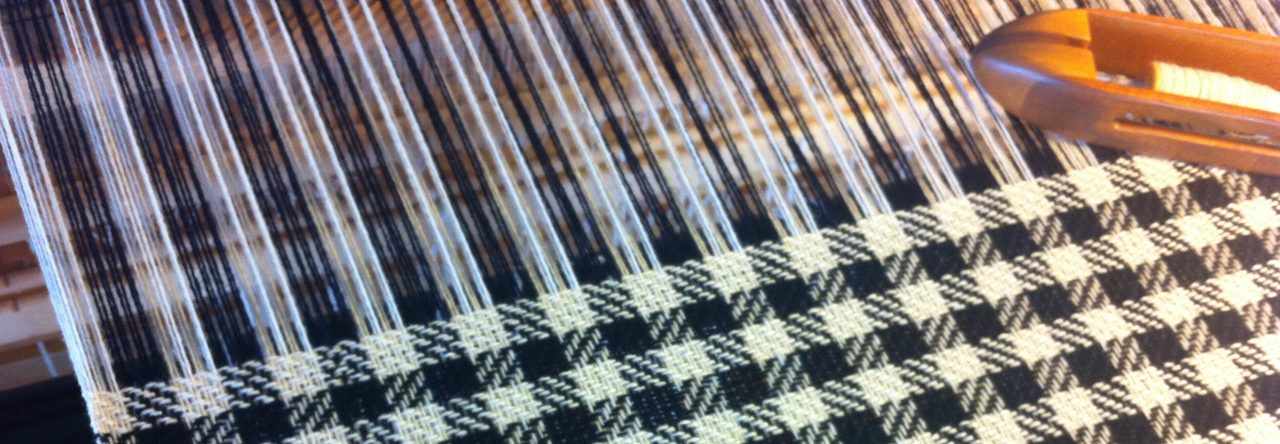
Creativity For as long as textiles have been created - whether by braiding, felting or weaving - craft-workers have been combining the functional requirements of the cloth with creative ideas. This may have been to enhance the textile's warmth or strength, to introduce different fibres, or to change the look of the textile with new dyes, pattern weaves, manipulation or sewing techniques, …
The Huldremose Woman has more to tell us
There is an interesting story I’d like to share - which has emerged from the research of Margarita Gleba and Ulla Mannering. Their articles are referenced below. It was sometime in the 2nd century BC, and a woman living in north-eastern Jutland, Denmark was about 40 years old - an advanced age in this period. …
A change of focus … and a bit less weaving
I don't have any of my own weaving to show you this month. The fact is that for most of the next year I'll be away from home - and away from my loom! But the good news is that my husband is going to be doing an MPhil at Cambridge, and I will be …
Diamonds and Broken Diamonds
Diamond twill is an ancient weave which has been identified in textiles dating back thousands of years. I think it is a beautiful, symmetrical and versatile pattern that combines well with borders in a point twill, or with variations of beautiful 'bird's eye' designs. (It also works quite well with a stripey warp, as you can …
A warp-weighted Tablet Weaving Loom
I’m enjoying teaching myself about tablet weaving, through some reading and a lot of trial and error. Over the past few months I’ve spent quite a while experimenting with ways to make sure that I’ve got the right tension on the warp. And after a few false starts, the very ancient idea of using loom weights occurred …
Celtic Knots
I found an interesting pattern for weaving a Celtic knot design, so I am giving it a try. (Thank you Robyn Spady. http://www.weavezine.com/content/kiss-me-i%E2%80%99m-irish) Of course it won’t be authentic as far as Celtic weaving design goes. As I have written about already, Celtic weaving originated in pre-Roman Europe and consisted largely of checked patterns and …
The earliest Scottish Tartan
I am ready to get back to weaving Celtic designs again, after a couple of months of working on those two blankets. This time, in recognition of the resounding vote by the Scottish in last week's British election, I am weaving a Falkirk tartan - generally described as being the earliest known example of a …
The Celts of Iron Age Europe
Sometimes discussion of the Celts can inspire romantic or fanciful notions which bear little relation to the archaeology of the European Iron Age. In fact, archaeologists and historians continue to debate the meaning of the word 'Celt' as it relates to these Iron Age cultures, since it doesn't seem to correlate well with either their ethnicity or socio-political …
Tablet Weaving
Tablet weaving (also known as card weaving) is an ingenious technique for taking long bundles of warp threads and passing them through perforated tablets, then manipulating these to make strong patterned bands. Historically this was done with either a back strap method or a structured loom. To weave with this technique, each card is normally …
The Warp Weighted Loom
The warp weighted loom has been found in European archaeology as far back as the Neolithic period, more than 6000 years ago, so in Northern Europe and Scandinavia this has been the dominant weaving technology for 5 of the past 6 millennia. The distinctive feature of this type of loom is the use of clay …