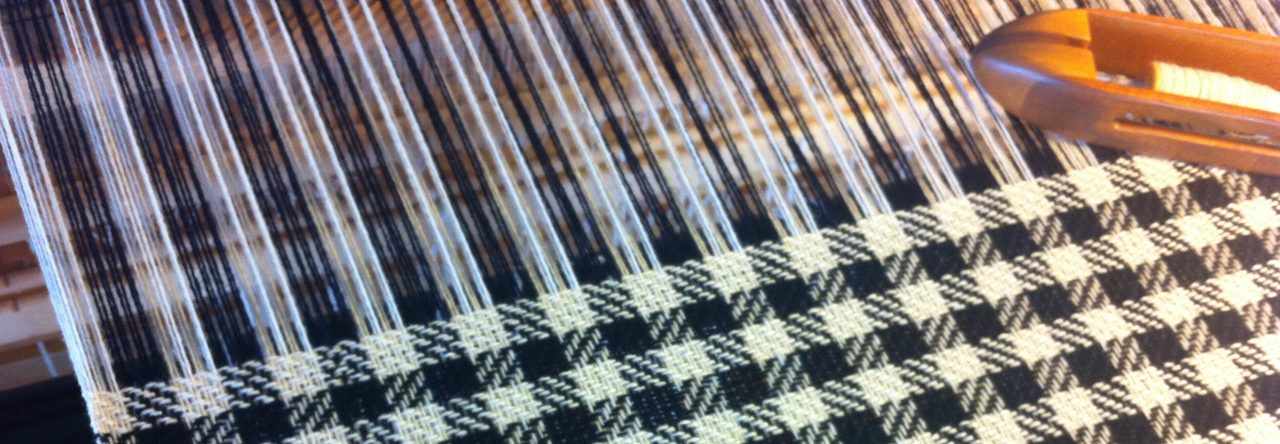
Tools of fibre processing and cloth finishing in Anglo-Scandinavian York.
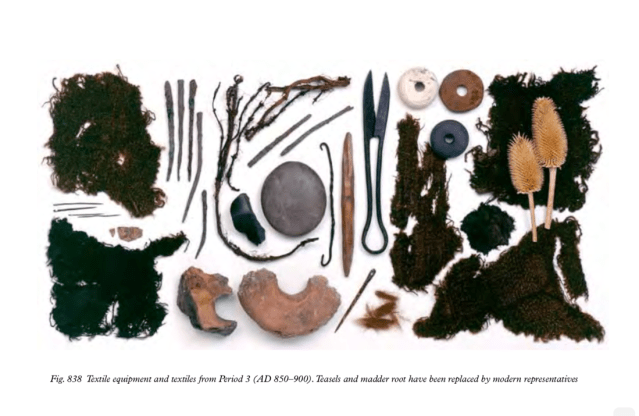
Textile making was a common domestic activity throughout the 5th to 10th century in Europe, so it’s not unusual for archaeologists to find a loom weight or a spindle whorl in Early Medieval sites. The Coppergate site in York has been extraordinary, however, for the wealth of textile making tools discovered dating from the Roman period right through to the 15th century. (Walton Rogers 1997, p 1709)
For this post, as with last month, the focus is on the Anglo Scandinavian period of the 9th and 10th century. And as with last month, all of the wonderful illustrations come from the archaeological report, referenced at the end.
Fibre Processing
Wool
Wool would have been widely available from local farms and pasture, and it was evident in the archaeology that as well as brown and gray wool fragments, there was more white wool in York than in other parts of northern Britain. This makes sense given the extent of wool dying that was discovered there, since it is white wool that’s normally used for this.
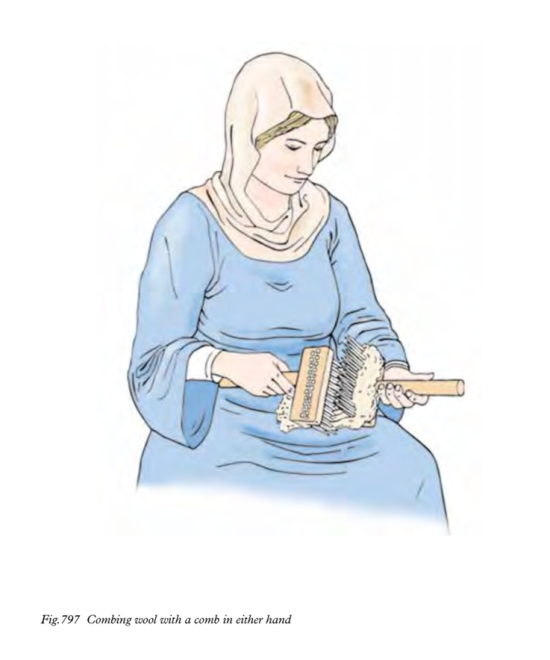
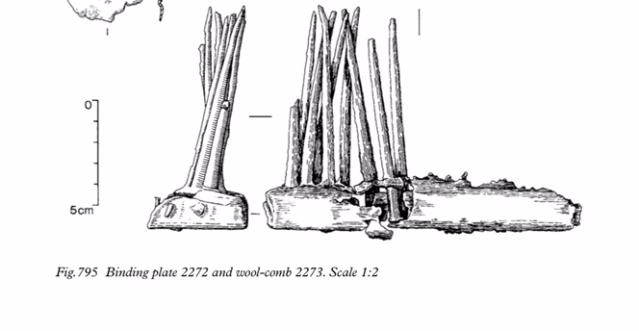
There is evidence that the washing of the wool was done with of a type of clay like fuller’s earth, since the detergents used today would not have been available. After washing, the wool would have needed combing to loosen and separate the fibres, usually with two hand-held combs. A wool comb was found at the Coppergate site with two rows of iron teeth still set in a wooden base.

Flax
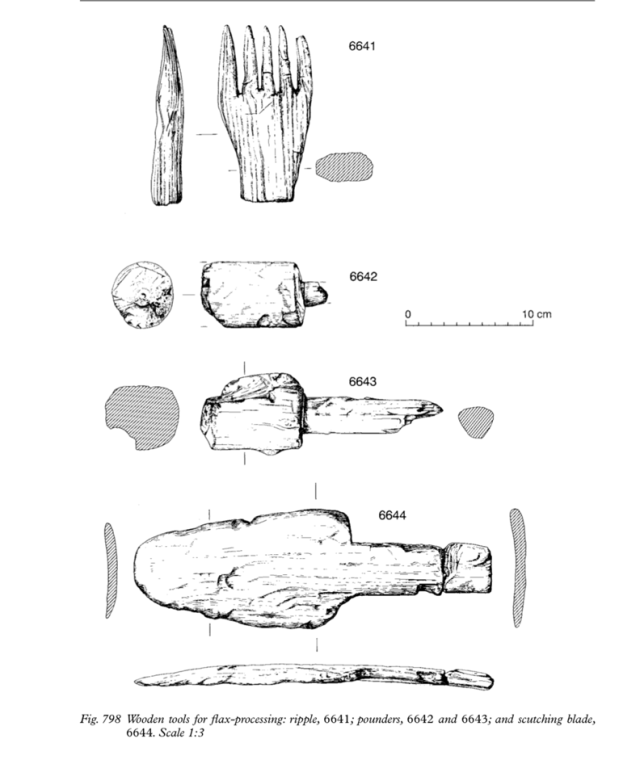
Flax fibre comes from the stems of the plant, and is separated from the woody core by a series of processes. First the stems are broken up with a wooded tool called a ripple. Then they are soaked in water for as much as two weeks, a process known as retting. After that, the stems are put out to dry, and pounded with a beetle to break up the fibres. The fibre is next treated to remove any remaining plant debris. This is called scutching, and involves using a blade to beat bundles of fibres against a board. And finally, heckling: the bundles of fibres are separated by combing them with a series of finer and finer iron teeth, mounted vertically on a wooden base. (Walton Rogers p 1719 – 31)
Dying
A variety of dyes have been found at the Coppergate site, in particular woad, madder, greenweed and weld. Woad is a blue dye, and is activated by soaking the cloth, or yarn, long enough for there to be fermentation and oxidation. The other dyes need a mordant to fix the dye, and although it’s usual today to use alum as a mordant, this would not have been available in Coppergate, and there is evidence that clubmoss was used as a substitute, probably imported from Scandinavia or Northern Germany. Madder is a red dye, and was the most common in this site, both in terms of finding the remains of red cloth and also from large red stains on the ground. Madder was commonly imported to this area from northern France. Greenweed and weld both create a yellow dye, and may have been grown locally.
Although both wool and linen were dyed, there are also many examples of undyed garments – in particular linen, which was commonly boiled with wood ash and then stretched on a frame to be bleached in the sun. (Walton Rogers p 1766-70)
Finishing
Wool
Once wool has been woven and washed, it can be used without any further processing. For a high quality, durable cloth, though, it was common to full, teasel and shear the cloth to create a denser texture and a nap. Fulling involves wetting and then agitating, rubbing or stamping on the cloth to create a thick felted texture. Teaselling and shearing are additional processes for raising a nap on the cloth. Teasles are set on a frame and used to brush the cloth. For shearing, the cloth is mounted on a bench and the surface trimmed repeatedly with shears to create a smooth felt.
At Coppergate there were several tools discovered which would have been used in this activity: tweezers, a shearboard hook, and a tenterhook, used for stretching out the fulled cloth.

Linen
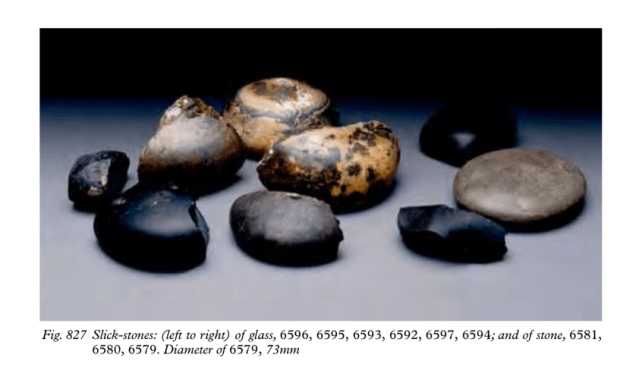
After a linen garment was made, it was routine after laundering to repeat these steps each time. The linen would be beaten with a club or mallet and then, especially along the seams, a glass slick-stone was used to flatten the linen and smooth the seams. (Walton Rogers p 1771-79)
Sewing
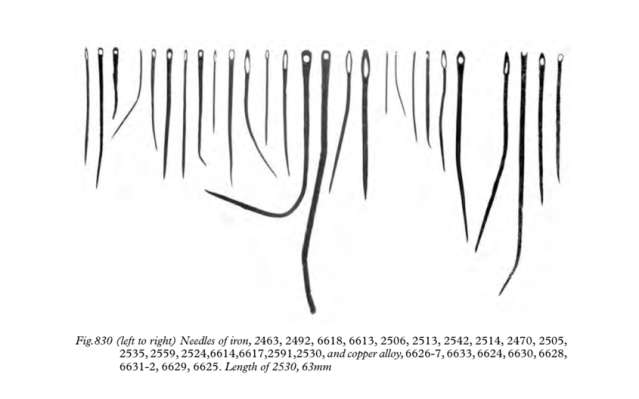
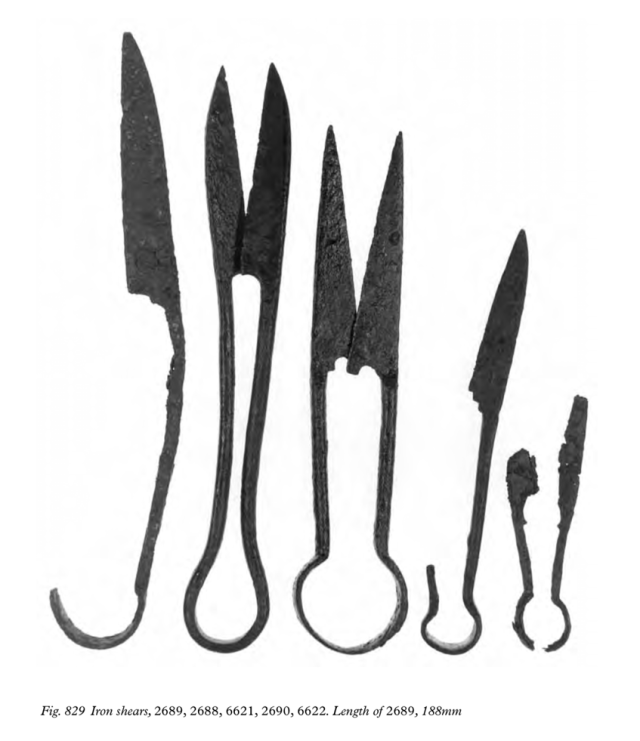
Many examples have been found of clothing fragments with seams and hems visible. There is also – not surprisingly – extensive evidence of sewing in the archaeology. Needles of bone, iron and copper have been found, and many shears both large and small.

References
Walton Rogers, P. 1997. Textile Production at 16 – 22 Coppergate: The Archaeology of York: The Small Finds. York: Council for British Archaeology.
Images
Walton Rogers, P. 1997. Textile Production at 16 – 22 Coppergate: The Archaeology of York: The Small Finds. York: Council for British Archaeology.
 Celtic Weaving