Tools for spinning and weaving in Anglo Scandinavian York.

The archaeological site of Coppergate is an exceptional source of textile working materials over an evolving period of many centuries. This extraordinary site is located within the city of York, in the north of England. Enclosed between two rivers, the Ouse and the Foss, it borders the street still known as Coppergate. (Walton Rogers 1997: p. 1689). All of the beautiful images in this post come from the official publication of this excavation, referenced below.
The earliest known settlement at Coppergate was in the Roman period, between the late first to the 4th centuries, and this archaeological context is directly below the Anglo-Scandinavian site. Nearby is the Anglo Saxon site at Fishergate, which was occupied from the 7th to the 9th centuries, and during this time the Coppergate site seems to have been deserted. It was only in the late 9th and 10th centuries, in the era of Scandinavian settlement, that Coppergate was redeveloped. The remains of post and wattle buildings were found along the street frontage along with four distinct tenements. (WR p. 1690).
A wealth of finds associated with textile making was discovered at the Coppergate archeological site, showing signs of both Roman and Anglo Saxon influence.
There is evidence of fibre processing of wool and linen, spinning, weaving and also of finishing, dying and sewing of cloth. In fact, there is so much that I have divided it all into two posts. This month I’m focusing on the finds associated with spinning and weaving.
Spinning:
A wide variety of spindle whorls were found, mostly made of local stone, and including many which were incised to create patterns of herringbone, zig zag, cross-hatching and ring-and-dot. Penelope Walton Rogers makes the observation that this kind of decoration is also seen in the bone and clay spindle whorls of Merovingian and Carolingian Netherlands, but are rarely seen in the Viking period in Scandinavia. Also, there were very few of the conical-shaped clay spindle whorls which were commonly associated with Viking Scandinavia. (WR p. 1742). So this certainly suggests that there was a significant Anglo-Saxon influence at this settlement.


Weaving:
Warp weighted loom
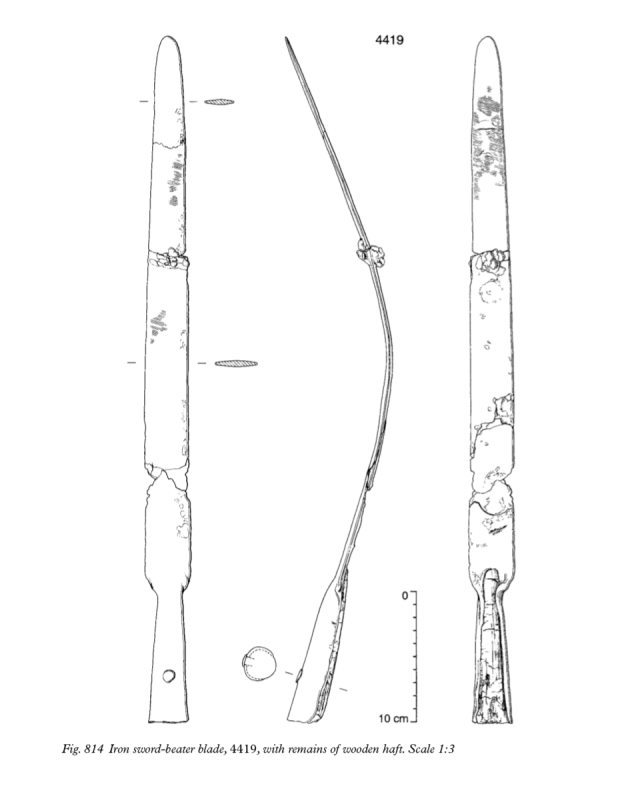
The warp-weighted loom is traditionally associated with both Anglo Saxon and Scandinavian culture. Constructed of two vertical posts with the cloth beam at the top, the warp is tensioned by tying bunches of warp threads to loom weights so that they’re hanging. On these looms the warp can be up to four metres wide, allowing two weavers to walk back and forth, beating the warp threads upwards with long sword beaters or spear beaters. Clear evidence of warp weighted looms can be seen in the Coppergate settlement based on the finding of beaters along with stone or clay loom weights.

Vertical two-bar loom
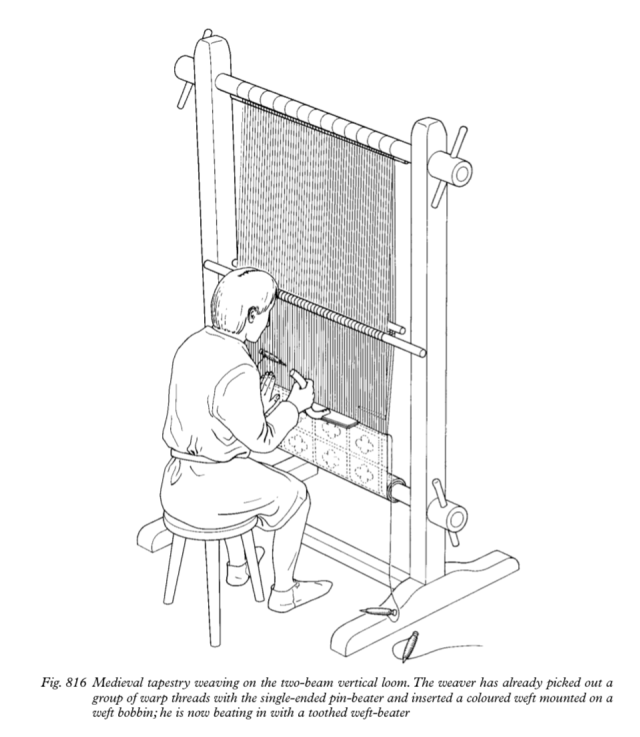
Another influence comes from the history of Roman settlement in this area. While the Scandinavian and Anglo-Saxon traditions both favoured the warp-weighted loom, the Romans relied on the vertical two-bar loom for textile production. This was a more compact loom, and with both ends of the warp secured to the loom there was no need for loom weights to create tension. An added benefit of this was that weavers could sit to weave instead of standing, and beat downwards instead of up. The disadvantage is that the vertical two-bar loom tends to be smaller, creating a narrower length of cloth. It’s been suggested that this would explain the persistence of both types of looms at Coppergate, as they were used to created different types of cloth.
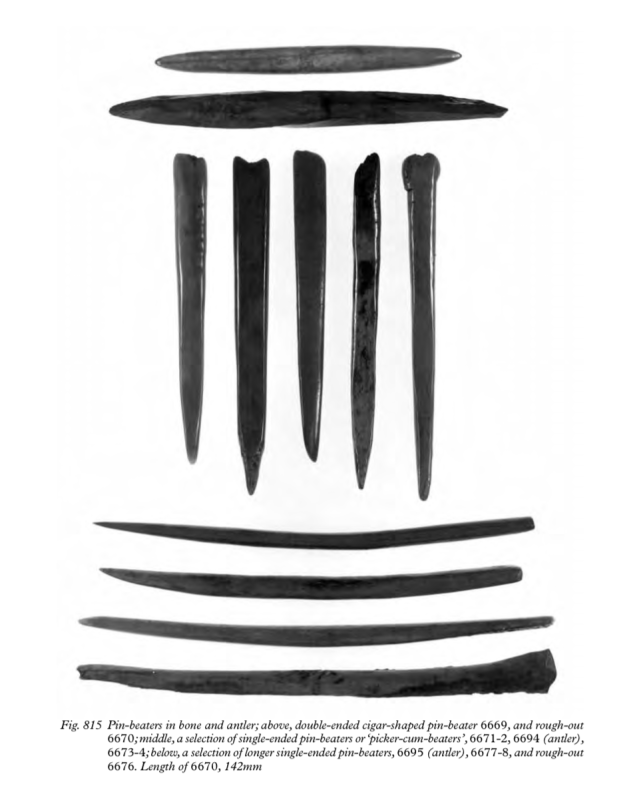
The main tool associated with a vertical two-bar loom was the single-ended pin beater. Made of antler or bone, this was a flat device, used to pick up groups of warp threads, straighten the warp and align the weft threads as the weaving progresses. Evidence of vertical two-bar looms are less visible in the archaeology because the loom is made entirely of wood, so the main sign has been the finding of pin beaters rather than loom weights.
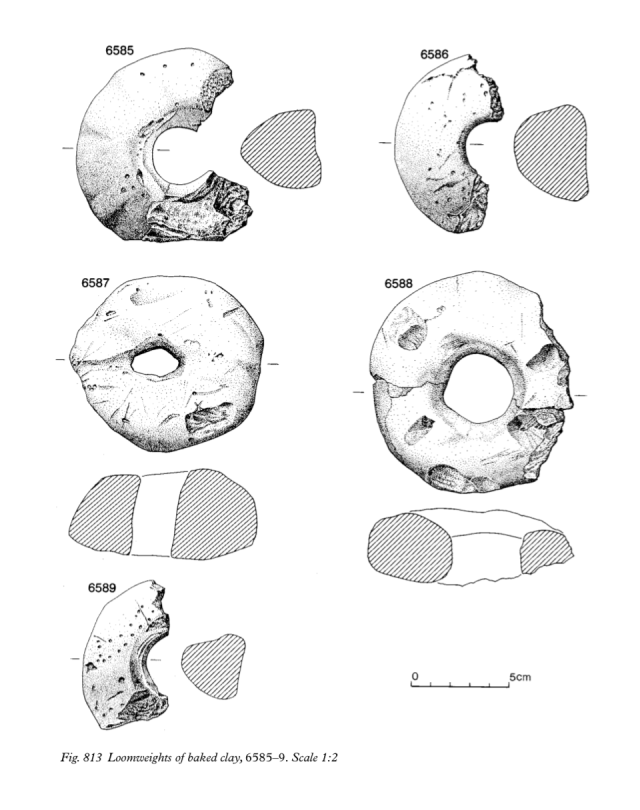
There were 33 loom weights found in the Anglo Scandinavian tenements of the Coppergate site in York, all roughly fired and of brick clay, which would have been locally available. They are all of intermediate size and either ring or bun shaped. But given the extent of textile production at Coppergate, Walton Rogers was surprised to find such a small number of loom weights. She suggests that one reason could be that in the 9th and early 10th century, the warp weighted loom was gradually being replaced by the vertical two-bar loom. All of the single-ended pin beaters were found in the archaeological context that is consistent with this theory, i.e. the beginning of the Anglo-Scandinavian period – late 9th and early 10th century.
Chronology of looms
Based on the finds of pin beaters, vertical two-bar looms were prevalent in the period of Roman occupation, limited in the Anglo Saxon period (5th to 10th centuries in Britain) and then re-introduced around the 9th century period of Scandinavian immigration.
Although the warp-weighted loom continued in use in rural areas around York, the urban settlement in 9th and 10th century Coppergate seems to have become a site of high-production textile manufacture, with the vertical two-bar loom taking precedence. (WR p. 1824).
This pattern of innovation in the town alongside the persistence of traditional technology in the rural area is not only understandable, it has an exact precedent in the period of Roman Britain. Warp-weighted looms were found in the ‘least Romanized” parts of Britain while the vertical two-bar loom, introduced by the Romans, was found in the towns. (Wild 1970: p. 67).
Next time, I’m looking forward to taking a closer look at all the tools associated with teasing and carding fibre in preparation for spinning. Also, the tools and materials that would have been used for finishing, dying and sewing the final garments.
Next month:
Archaeology of Textile Making at Coppergate – 2 Tools of fibre processing and cloth finishing in Anglo-Scandinavian York
References
Walton Rogers, P. 1997. Textile Production at 16 – 22 Coppergate: The Archaeology of York: The Small Finds. York: Council for British Archaeology.
Wild, J.P, 1970. Textile Manufacture in the Northern Roman Provinces. Cambridge: Cambridge Classical Studies.
Images
Walton Rogers, P. 1997. Textile Production at 16 – 22 Coppergate: The Archaeology of York: The Small Finds. York: Council for British Archaeology
 Celtic Weaving