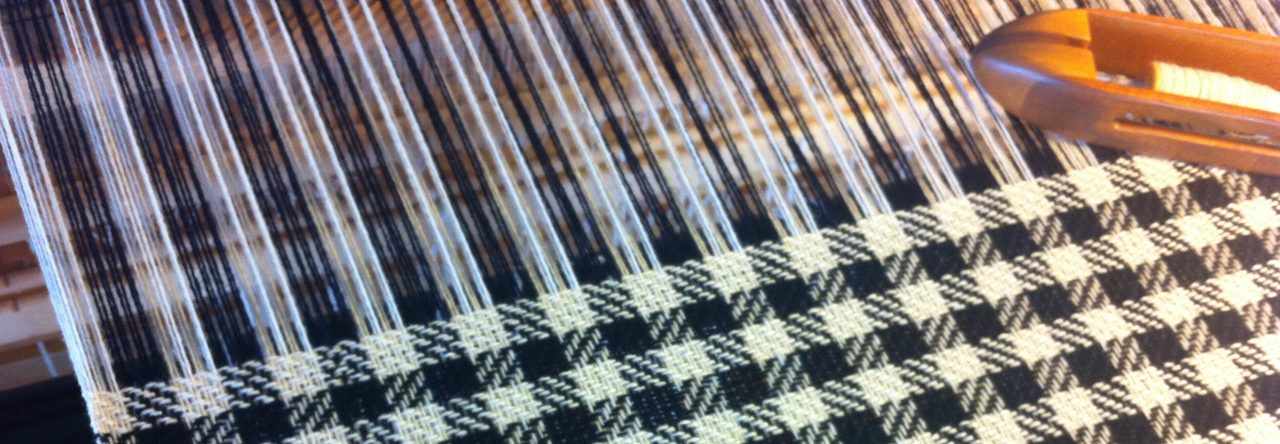
Weaving is an ancient craft, and an early solution to countless practical needs. In Iraq and Turkey, archaeologists have discovered clay fragments with the impression of woven cloth pressed into them, dating from the Neolithic period as early as 7000 BCE (Barber, 1994). And long before that, humans were intertwining grasses, reeds and branches to create baskets, floor mats, shelters and fences.
The simplest weave structure is plain weave, or tabby. This is both durable and stable, and can be created by hand in the weaving of mats or baskets. For textiles, though, the warp threads need to be secured on a loom so that they can be lifted together to create a ‘shed’ for the weft to pass through. The weft crosses alternate threads of the warp, so there is only the need for two sheds; either the even-numbered warp threads are lifted, or the odd-numbered. This weave has no ‘floats’, and as a result is secure, smooth, and strong.
With a twill weave, the weft thread can pass over two or more warp threads with each pass, creating a pattern of diagonal lines in the cloth. This is not only an attractive design, but creates a more flexible cloth with softer drape. A twill pattern also means that there is great versatility to the weave. By varying the way that the warp is tied up (and the sheds created) a whole variety of weave patterns are possible.
Today, handweavers are able to create endless variations of complex pattern weaves. However, in the context of Northern Europe during the Iron Age, the variety seems to have been more limited. On a warp-weighted loom, where it is possible to pass a weft over no more than 2 weft threads, there is evidence of plain weave, basket weave, 2/1 twill and broken diamond twills.
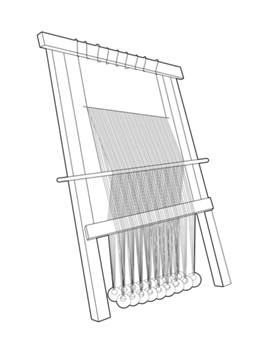
With a vertical 2-bar loom, of the kind introduced by the Romans, longer ‘floats’ are possible and as a result we see vertical and horizontal point twills, diamond twills and herringbone.

I have redesigned my weaving gallery this month to make it easier to see all of these different historical weaves, and how they relate to each other. Have a look! https://celtic-weaving.com/weaving-gallery/
References
Barber, Elizabeth, Women’s Work, the First 20,000 Years, NY: Norton, 1994, p 78
Images
Warp weighted loom: https://www.outofframe.mit.edu/allposts/weaving-glossary
Vertical 2-bar loom: Wild, J. P. 1970. Textile Manufacture in the Northern Roman Provinces. Cambridge: Cambridge Classical Studies p. 175
 Celtic Weaving