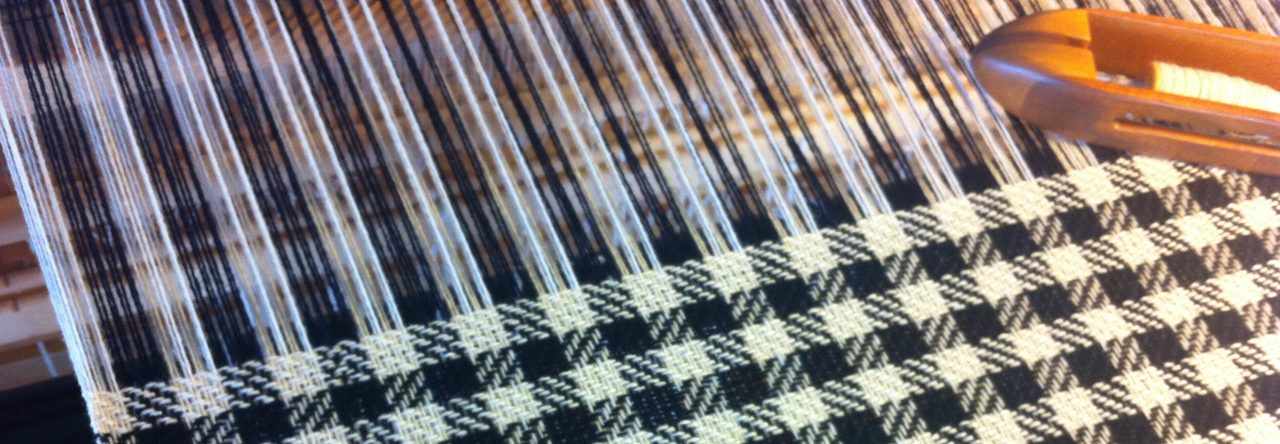
I have been experimenting with different yarns for tablet weaving … and there has been plenty of trial and error! But I’ve learned a few things. Some are life-lessons I have resisted for years, like: it is much easier to get it right the first time that to fix things once they are all wrong. And a related lesson: read the instructions really carefully.
Also, Shetland wool is a bit of a challenge in this work. It is not very strong and has a tendency to snap in the warp, and it is also very sticky so the tablets do not turn so easily. Warp threads need a stronger yarn. The Celts and Vikings must have been so excited to discover their imported silk for this – it’s strong, brightly coloured, and so smooth and slippery that the tablets turn without any resistance! I have turned to embroidery silk and cotton.
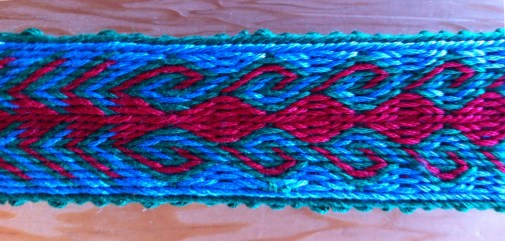
There are all kinds of patterns for tablet weaving from simple to really mind-bending. For now I’m working on something called a Double Ram’s Horn which is quite amazing. Sometimes all the cards move in the same direction, and sometimes certain ones go forward while others go backwards. (Multi-tasking is not yet an option when I’m doing this, I need to focus!)
I have posted a new page to this site now on the history and archaeology of tablet weaving. The next page I’m working on will be a backgrounder on the European Iron Age, and about how Celtic culture emerged in this period.
Stay tuned: February I warp up the floor loom and will start weaving some wonderful Anglo Saxon and Viking designs: Herringbone, Broken Diamond Twill, Basket Weave and Rippenkoper. I think I’ll be on safer ground here.
 Celtic Weaving
Perhaps the Celts found a solution to using wool?
LikeLike
Yes, they did. Thanks for raising that question. Some sheep breeds have long-staple wool can be combed and spun tightly. Others have shorter curly wool that gets carded and doesn’t take such a tight spin. So long-staple wool is much stronger for using in the warp.
LikeLike